



Chiropractic care that goes
beyond the adjustment.
Most people have tried chiropractic, felt better for a week, then ended up back in the same pain. That isn't a chiropractic problem. It's a treatment model problem. Here, the adjustment is one part of finding and fixing what's actually causing it.
Your spine moves.
When it stops moving well, everything downstream pays for it.
Your joints, especially the ones in your spine, need to move freely and in the right order for your body to work without pain. When a joint loses its normal range, the muscles around it tighten to protect it, the joints next to it pick up the extra work, and eventually your body sends pain to get your attention.
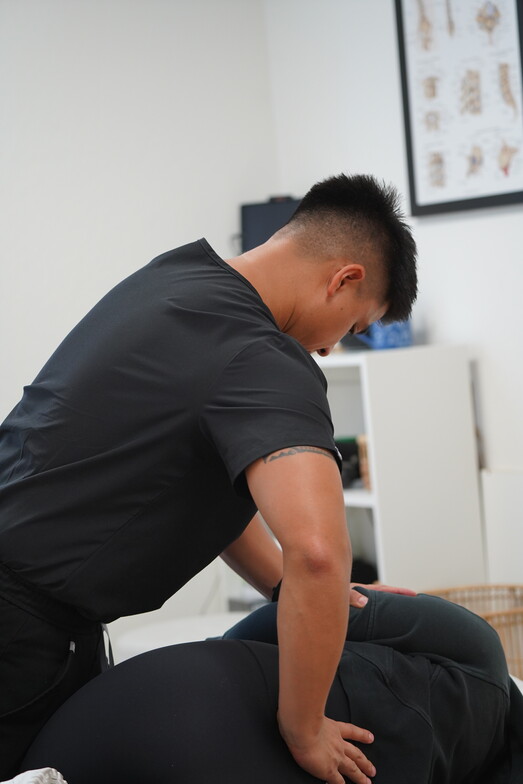
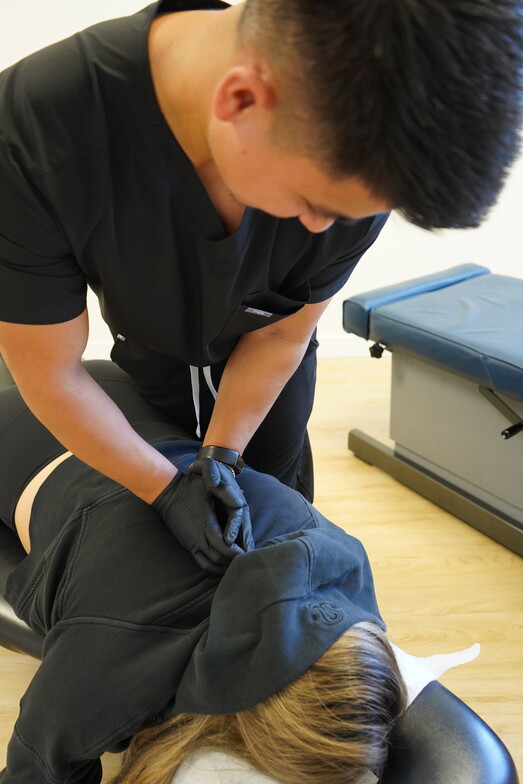
An adjustment restores motion to a stuck joint. It's a precise, controlled input to one specific joint, not a general crack of your back. Done well, it eases the tension in the joint, calms the pain response, and gives the muscles around it a window to start working properly again.
We find the movement problem first.
Then we treat it.
Most chiropractic offices start with where it hurts. We start with how you move. Before any treatment, Dr. Cagape watches you move through a set of basic patterns to find where the breakdown actually is, because where you feel pain and where the problem lives are rarely the same place.
Relief now,
or rebuilding so it stops coming back.
Both are legitimate reasons to come in, and you'll get an honest recommendation at your exam rather than a push toward the more expensive one.
About 15 minutes. A focused adjustment for something that's flared up, or regular upkeep if you already know what your body does. Soft tissue therapy can be added.
Soft tissue +$50, or +$30 as a member
45 minutes, about 6 to 8 visits. Every visit: a movement re-check, an adjustment, soft tissue work, and corrective exercise coached in the room. Soft tissue is included.
Billed one visit at a time, no package
If it involves how you move,
we can help.
The common thread across everything below: a joint, a muscle, or a movement pattern that has stopped working the way it should.
Low back pain is the number one reason people see a chiropractor, and one of the most misunderstood. In most cases the pain in your low back is not where the problem started. A stiff hip, a stiff mid back, or a hip that won't bend properly all force your low back to make up the difference, and eventually it gives out under that load.
Neck pain and headaches increasingly come from the same source: a stiff upper back that forces your neck to compensate for every reach and every turn of your head. Hours at a desk or on a phone speed that up. Adjusting the neck and upper back, then strengthening the deep neck muscles and freeing the mid back, addresses the pattern rather than just the sore spot.
Shoulder pinching, rotator cuff pain and pain at the top of the shoulder are often the result of a mid back that won't rotate or straighten properly, which leaves the shoulder working in a compromised position on every press and overhead reach. Treating the shoulder on its own, without freeing the mid back and retraining the shoulder blade, gives temporary results at best.
Sciatica, meaning pain, numbness or tingling that runs from your low back into the glute and down the leg, is one of the most disabling things we see. It can come from a disc, from a muscle deep in the glute pressing on the nerve, or from the joint at the back of the pelvis. Getting that right matters, because each one needs a different approach. The exam is how we tell them apart before treating anything.
Active people don't just need to get out of pain, they need to get back to doing the thing without it happening again. Dr. Cagape's trainer credential means the rebuilding is part of the plan from day one: the movement that caused it, how much load you can handle, and a progression that actually gets you back rather than leaving you at "cleared for activity."
Sitting eight or more hours a day in front of a screen produces a predictable pattern: the front of your hips tightens, your glutes go quiet, your mid back stiffens forward and your head drifts ahead of your shoulders. The result is pain in your low back, mid back, neck and shoulders, plus headaches, all coming from the same place. Extremely common around here, and very treatable once someone actually looks for it.
Is chiropractic safe?
Yes, and here's what to expect.
Chiropractic care has a strong safety record and serious complications from spinal manipulation are rare. Mild soreness for a day or two after the first few visits is common, much like the soreness after a workout, particularly if you've been stiff for a long time.
Frequently asked.
Does an adjustment hurt? +
Once I start, do I have to keep going forever? +
How is this different from a walk-in adjustment place? +
Do I need imaging or an X-ray first? +
Can I be adjusted if I've had surgery or have a health condition? +
What does it cost? +
Do you take insurance? +
Do I need a referral? +
Find out what's actually
causing your pain.
Your first visit includes a full movement screen, a region-specific orthopedic exam, your report of findings, treatment the same day, and a plan with a real number on it. Ask about the membership while you're there.
Book My $180 New Patient Exam → or call / text (408) 519-2269Modern Movement Chiropractic · 133 S. Main St, Milpitas, CA 95035 · (408) 519-2269 · Dr. Daniel Cagape, DC, CPT · California Licensed Chiropractor
