Slideshow image
Slideshow image
Slideshow image
Slideshow image
nav image
nav image
nav image
nav image


Services  ·  Soft Tissue Therapy

An adjustment opens the joint.
Soft tissue work makes it stay open.

If you train hard, your muscles accumulate adhesions, scar tissue, and restricted fascia that no amount of stretching fully resolves. Soft tissue therapy directly targets the tissue quality that limits your movement, your strength, and your recovery — and at MMC, it's integrated with chiropractic and personal training, not treated as a standalone add-on.

Why It Matters

Your joints don't move in isolation.
The tissue around them does.

A chiropractic adjustment restores motion to a restricted joint. But the muscles, fascia, and connective tissue surrounding that joint develop their own restrictions — from training volume, past injuries, repetitive movement patterns, and chronic tension. These soft tissue restrictions don't respond to adjustments. They need direct, targeted work.

For active people and athletes, this is where the real work happens. Getting strong requires tissue quality. A hip flexor full of adhesions won't lengthen properly in a deadlift. A lat with chronic trigger points will limit your overhead press no matter how mobile your shoulder joint is. Soft tissue therapy restores the tissue quality that makes training productive and pain-free.

The Training Connection
Most people train around their restrictions. We remove them.

Dr. Cagape's dual DC + CPT background means soft tissue work is prescribed with the training goal in mind — not just the pain complaint. The tissue being treated, the technique used, and the corrective exercise that follows are all selected based on what movement pattern is restricted and what that restriction is costing you in the gym.

Before training
Release key restrictions before a session to unlock range of motion and allow full muscle activation in compound lifts.
After training
Accelerate tissue recovery and reduce next-day soreness by flushing metabolic waste and restoring tissue length after load.
Between sessions
Address chronic restrictions that accumulate over training blocks and limit progress in specific movement patterns.
Soft Tissue  ·  01

Cupping Therapy

Cupping uses negative pressure — suction cups applied to the skin — to decompress the layers of tissue beneath. While most soft tissue techniques compress into muscle, cupping pulls tissue apart. This decompression creates space in the fascial layers, increases local blood flow, and draws metabolic waste out of chronically tight tissue.

The marks left by cupping (called "petechiae") are not bruises. They're the result of stagnant blood and metabolic waste being drawn to the surface — a visible indicator of where chronic tension and poor circulation have been living in the tissue. They typically fade within 3–7 days and are not painful.

Static cupping
Cups held in place over a specific tissue target — most effective for localized trigger points, chronic muscular tension, and areas of restricted blood flow.
Dynamic cupping
Cups moved along a muscle belly while suction is maintained — creates a myofascial decompression effect along the full length of the muscle and its fascial envelope.
Active cupping
Patient moves through a range of motion while cups are applied — combines decompression with active tissue loading for athletes preparing for or recovering from training.
Best for
Chronic muscle tension Upper trap & neck tightness IT band restriction Hip flexor tension Post-training recovery Thoracic mobility Hamstring restriction Plantar fascia
Soft Tissue  ·  02

Graston Technique (IASTM)

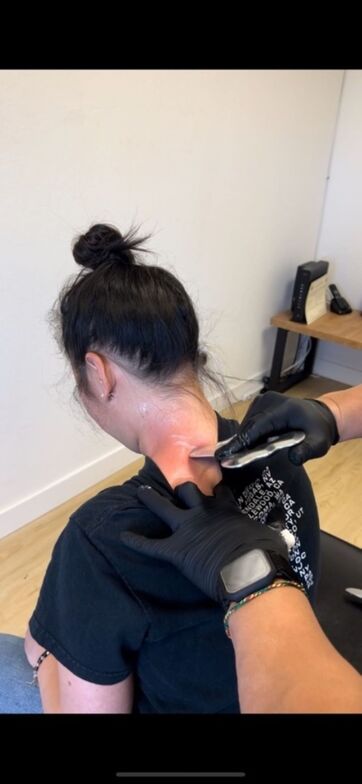
Graston Technique is a form of instrument-assisted soft tissue mobilization (IASTM) that uses specially designed stainless steel instruments to detect and treat scar tissue, fascial restrictions, and chronic soft tissue dysfunction. Dr. Cagape is Graston Technique certified — the original and most clinically validated IASTM system, used extensively in sports medicine and rehabilitation.

The instruments are designed to amplify the clinician's ability to detect tissue abnormalities — scar tissue and fascial adhesions transmit a distinct vibration through the tool that hands alone can't feel as precisely. Once located, the instrument applies targeted shear force to break down the restriction and stimulate fibroblast activity, which triggers collagen remodeling and genuine tissue repair.

Why it outperforms manual therapy alone
Detects what hands miss. The instruments transmit tissue feedback that allows the clinician to precisely locate fascial restrictions and scar tissue in early stages — before they become symptomatic movement limitations.
Breaks down scar tissue. Controlled mechanical stimulation disrupts fibrotic tissue and adhesions that manual pressure alone cannot mobilize — critical for post-surgical recovery and chronic overuse injuries.
Stimulates genuine repair. The controlled micro-trauma triggers fibroblast proliferation and collagen remodeling — the biological process that rebuilds healthy tissue architecture rather than just reducing symptoms.
Pairs with corrective loading. Graston followed by targeted exercise activates the newly mobilized tissue under load — reinforcing the neural pathway and making the improvement functional rather than temporary.
Best for
Tendinopathies Post-surgical scar tissue Plantar fasciitis IT band syndrome Rotator cuff restrictions Tennis & golfer's elbow Achilles tendinopathy Chronic neck & upper back restrictions Hip flexor adhesions
Soft Tissue  ·  03

Normatec Compression

Available on request  ·  No additional charge

Normatec uses sequential pneumatic compression — chambers in the sleeves inflate and deflate in a wave pattern that mimics the natural muscle pump — to flush metabolic waste, reduce inflammation, and accelerate circulation in the legs and hips. It's the recovery tool of choice across professional sports teams, endurance athletes, and high-volume training programs.

At MMC, Normatec is used as a complement to treatment — particularly after Graston or cupping work on the lower extremities, or as a pre-session warm-up for patients with chronic leg and hip tightness. It doesn't replace active recovery, but for patients who train hard and want to recover faster between sessions, it's a meaningful tool to have available.

Post-training recovery
Accelerates clearance of lactate and metabolic byproducts after hard training sessions, reducing soreness and restoring tissue readiness.
Pre-session warm-up
Increases circulation and prepares tissue for treatment or training, particularly useful for patients with chronic lower body tightness or poor baseline circulation.
After soft tissue work
Following Graston or cupping, compression helps flush the mobilized tissue debris and supports the lymphatic clearance of the inflammatory byproducts generated during treatment.
The Full Picture

Three tools. One goal:
tissue that trains and recovers.

Each soft tissue modality works on a different layer and a different mechanism. At MMC they're never used in isolation — they're selected and sequenced based on what your tissue needs and what your training demands.

C
Cupping decompresses
Negative pressure lifts fascia and muscle away from underlying structures, restoring glide between tissue layers, increasing local blood flow, and releasing chronic compressive tension — especially effective in the upper back, hip flexors, and IT band.
G
Graston remodels
Instrument-assisted shear force breaks down scar tissue, adhesions, and fascial thickening — the structural restrictions that accumulate over years of training, injury, and repetitive movement. Stimulates collagen remodeling so tissue rebuilds with correct fiber orientation.
N
Normatec recovers
Sequential compression clears metabolic waste, reduces localized inflammation, and restores circulation — accelerating the time between treatment or training and tissue readiness for the next session.
Corrective exercise locks it in
Every soft tissue session is followed by targeted movement — loading the newly released tissue through the pattern that was restricted. This is what separates MMC from a massage: the treatment prepares the tissue, the exercise teaches the nervous system to use it. That's how changes become permanent.
Pricing

Simple. No billing surprises.

Soft Tissue Therapy — Add-On
Cupping & / or Graston — Add to any office visit
Any combination of cupping and Graston technique added to a standard office visit. Duration and technique selected based on clinical need.
+$50
Foundational Movement Program — Included
Soft tissue included every session
The 8-session Foundational Movement Program includes soft tissue therapy alongside chiropractic and personal training in every session. No add-on required.
$150 / session
Normatec Compression
Available on request
Normatec compression is available during your visit at no additional charge. Just ask.
Complimentary

Train hard. Recover harder.
Move better.

Book a new patient exam. Dr. Cagape will assess your tissue quality, identify what's limiting your movement and recovery, and build a treatment plan around your training goals.

Book My $180 New Patient Exam → or call / text (408) 519-2269

Modern Movement Chiropractic  ·  133 S. Main St, Milpitas, CA 95035  ·  (408) 519-2269  ·  Dr. Daniel Cagape, DC, CPT  ·  California Licensed Chiropractor

CONTACT

Soft Tissue Therapy
Frequently Asked Questions
Cupping Therapy
What is cupping therapy and how does it work? +
Cupping uses negative pressure — suction cups applied to the skin — to decompress the layers of tissue beneath. While most soft tissue techniques compress into muscle, cupping pulls tissue apart. This decompression restores glide between fascial layers, increases local blood flow, and draws metabolic waste out of chronically tight tissue. The marks left by cupping (petechiae) are not bruises — they're stagnant blood and metabolic waste drawn to the surface — and fade within 3–7 days.
Does cupping hurt? +
Cupping creates a pulling sensation — not pain. The intensity is adjustable and Dr. Cagape works within your comfort level. Most patients describe it as a deep pressure or stretch. Some tenderness may occur over areas with significant chronic tension. The circular marks left after cupping are not painful and are a normal response to the treatment.
What's the difference between cupping and Graston? +
Cupping uses negative pressure (suction) to decompress tissue — lifting fascia and muscle to restore glide between layers and improve blood flow. Graston uses positive pressure via stainless steel instruments to break down scar tissue and fascial adhesions through controlled shear force. Cupping is better for chronic muscular tension, post-training recovery, and fascial restrictions across large areas. Graston is better for localized scar tissue, tendon adhesions, and chronic overuse injuries. At MMC, both can be used in the same session when clinically appropriate.
Graston Technique
What is Graston Technique and who can perform it? +
Graston Technique is a form of instrument-assisted soft tissue mobilization (IASTM) that uses specially designed stainless steel instruments to detect and treat scar tissue, fascial restrictions, and chronic soft tissue dysfunction. It is a credentialed technique — clinicians must complete formal training and certification to practice it. Dr. Cagape is Graston Technique certified, making him one of a relatively small number of chiropractors in the area trained in the original, most clinically validated IASTM system.
Does Graston hurt? +
Graston can produce some discomfort, particularly over areas with significant scar tissue or fascial restriction — this is normal and expected. Dr. Cagape adjusts pressure to your tolerance. Some post-treatment soreness for 24–48 hours is common, similar to a hard workout. Small reddish marks may also appear, which is a normal response that fades within a few days.
How is Graston different from a regular massage? +
Massage primarily targets muscular tension through compression and manipulation — excellent for relaxation and general soreness but unable to structurally remodel restricted fascia or break down scar tissue. Graston uses stainless steel instruments to detect and treat specific tissue pathology — scar tissue, fascial adhesions, tendon degeneration — that massage cannot address. At MMC, Graston is always followed by corrective exercise that loads the treated tissue through the restricted pattern, making improvements functional and lasting rather than temporary.
Can cupping and Graston be done in the same visit? +
Yes. When clinically appropriate, both can be used in the same session — typically cupping first to decompress the superficial fascial layers, followed by Graston to address deeper structural restrictions. The sequence and technique selection are based on what the tissue needs.
Normatec & General
What is Normatec compression and do you charge for it? +
Normatec uses sequential pneumatic compression to flush metabolic waste, reduce inflammation, and accelerate circulation — primarily in the legs and hips. It's used by professional sports teams for post-training recovery. At MMC, Normatec is available on request at no additional charge. It's particularly useful after lower body soft tissue work or as a warm-up before treatment for patients with chronic lower extremity tightness.
How many soft tissue sessions will I need? +
For acute restrictions, 2–4 sessions combined with corrective exercise often produce significant improvement. Chronic conditions with significant scar tissue typically require 6–10 sessions. Soft tissue therapy is part of a broader care plan at MMC — Dr. Cagape will give you a clear timeline after your first visit assessment.
Can soft tissue therapy help with sports injuries? +
Yes — it's one of the primary reasons active patients and athletes come to MMC. Graston is particularly effective for tendinopathies (Achilles, patellar, rotator cuff, tennis elbow) and post-surgical scar tissue. Cupping is highly effective for chronic muscle restriction and recovery from high training volume. Both are paired with progressive loading so rehabilitation always moves toward return-to-performance, not just symptom management.
Is soft tissue therapy included in the standard office visit? +
Soft tissue therapy is an add-on to any standard office visit at +$50. It is included in every session of the Foundational Movement Program ($150/session, 8 sessions). If you're unsure whether to add it, Dr. Cagape will recommend it at your visit based on what your tissue needs.
Who should not receive cupping or Graston? +
Cupping is not appropriate over broken skin, active rashes, sunburn, varicose veins, or areas with blood clotting concerns. Graston is not appropriate directly over acute fractures, open wounds, active infections, or areas of acute inflammation. Both are used with caution in patients on blood thinners. Dr. Cagape reviews your health history before any soft tissue treatment.
Ready to move and train without restriction?
Book a $180 New Patient Exam Call or Text Us