Milpitas  ·  Chiropractic & Movement Rehab

You know what hurts.
Nobody's told you why.

Pain is the bill for strength and movement you quietly stopped using. We find what you lost, then rebuild it.

Here's what we look for, and what it takes to fix it  ↓
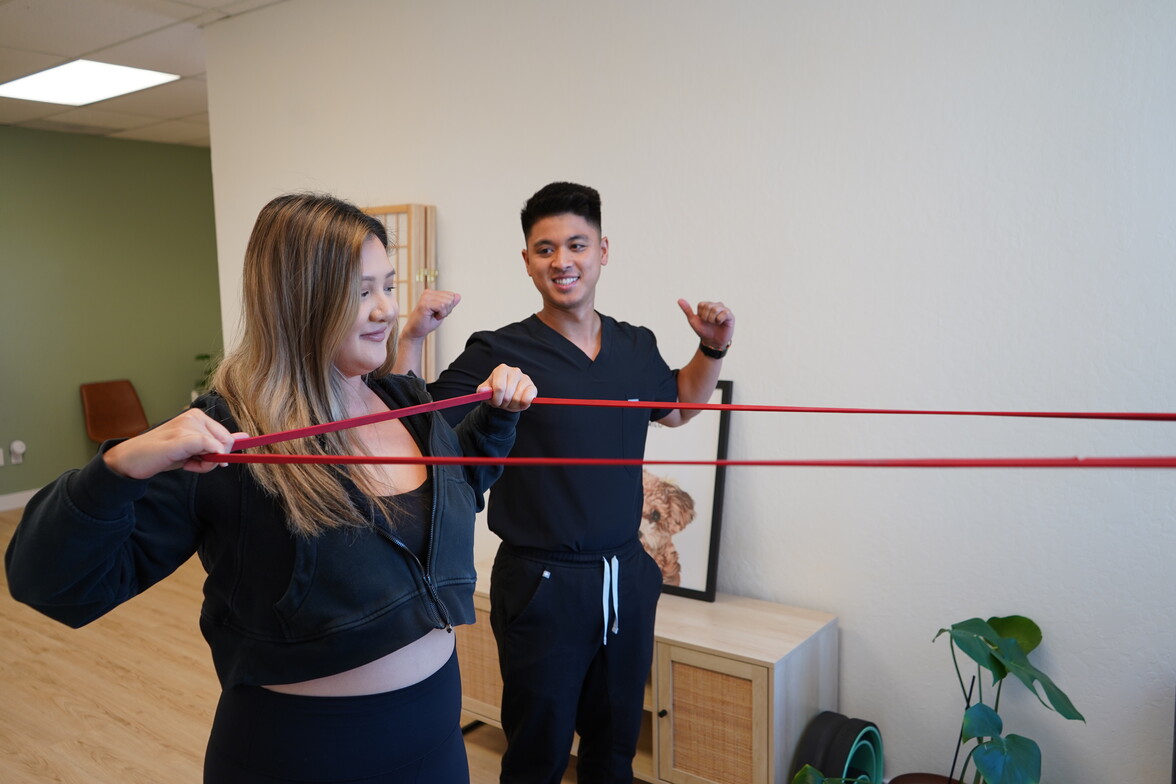
Dr. Daniel Cagape coaching a patient through a resistance band row at Modern Movement Chiropractic in Milpitas
Coached, in the office, with hands on you — not a printout.
Fig. 01  —  Exam Findings
Diagram: low back pain often traces to the hip, shoulder pain to the mid back, knee pain to poor hip control
Fig. 02  —  Why It Started Now
Chart: physical capacity declines over the years while daily demand stays flat; pain begins where they cross
Fig. 03  —  Why Eight Visits
Chart: nerve and brain adapt in weeks 1 to 4, muscle changes in weeks 5 to 8, tendon needs 12 weeks or more
What the research actually says
Weeks 1–4 — your brain relearns the muscle +

When a muscle stops getting used, it doesn't only get smaller — your nervous system stops recruiting it properly. That part comes back first, and it comes back fast. The classic study on this found that in the first four weeks of an eight-week program, essentially all of the strength improvement came from nerve and brain adaptation rather than any change in the muscle itself.

What that means for you: you'll feel more stable and often less painful inside the first month. Real, and worth having. But nothing structural has changed yet, which is exactly why stopping here is the mistake most people make.

Moritani T, deVries HA. American Journal of Physical Medicine, 1979;58:115–130.
Weeks 5–8 — the muscle itself changes +

This is where the tissue catches up. Muscle biopsy research has detected real increases in muscle fiber size by around week six, and ultrasound studies measuring muscle thickness have picked up increases as early as week four. Researchers still argue about the exact week — but the findings cluster firmly inside this window.

What that means for you: the improvement stops depending on us. The joint holds its position between visits, the corrected pattern survives being loaded, and the symptom stops returning on its old schedule. Eight visits at roughly weekly spacing puts you past that line — which is the entire reason the recommendation is eight and not four.

Staron RS, et al. Journal of Applied Physiology, 1994;76:1247–1255.  ·  Abe T, et al. European Journal of Applied Physiology, 2000.
Week 12 and beyond — if it's a tendon +

Tendon runs on a slower clock than muscle. Muscle strength responds in roughly six to eight weeks; tendon generally needs twelve weeks or more of consistent, progressively heavier loading before it changes structurally. In a controlled trial on Achilles tendon pain, only the twelve-week high-load protocol produced measurable increases in tendon stiffness and thickness.

What that means for you: if your exam points to a tendon — Achilles, kneecap, rotator cuff, glute, tennis or golfer's elbow — eight is not your number, and you'll be told that at your first visit with an honest one instead. Not at visit eight.

Radovanović G, et al. Sports Medicine – Open, 2022;8:149.
Billed one visit at a time. You're not signing up for eight today, and you can stop whenever you want. We'd rather you understood the number than committed to it blindly. These studies describe how tissue responds to loading in general — they aren't a guarantee of your individual result.
Inside a 45-Minute Visit

What it actually looks like.

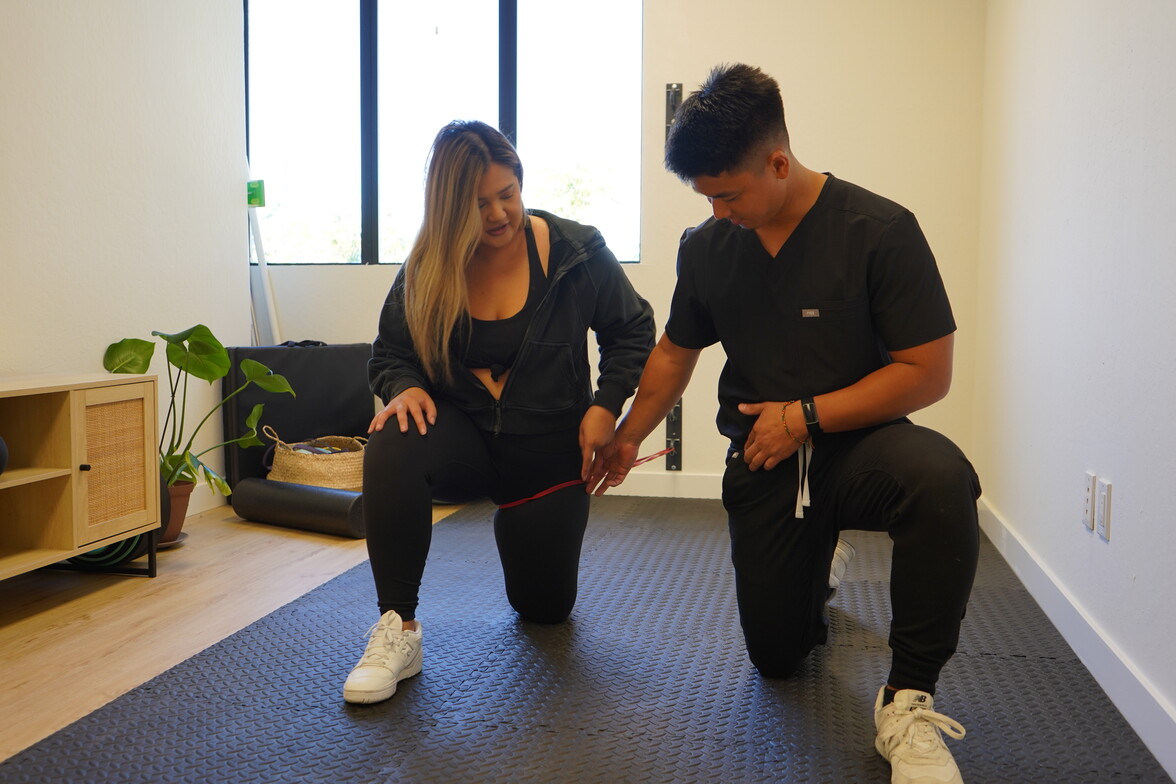
Dr. Cagape setting up a half-kneeling resistance band exercise with a patient
The exercise gets taught
Position, tension, tempo — set correctly the first time, so it's right when you do it at home.
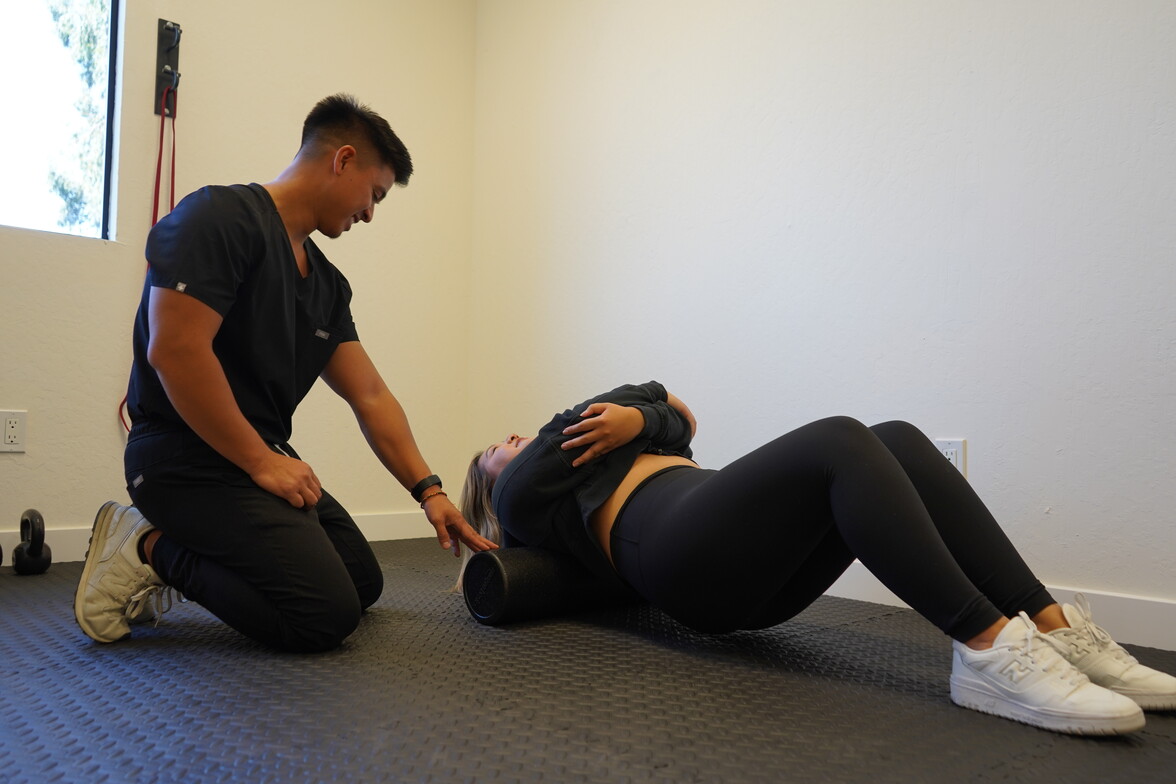
Dr. Cagape guiding a patient through thoracic mobility work over a foam roller
The restriction gets opened first
Adjustment and soft tissue work before loading, so you're training through good movement instead of around a stiff joint.
Fig. 04  —  Two Kinds of Visit
Comparison: $150 45-minute Foundational Movement Program visit versus $60 15-minute standard office visit
Want to know which one you've got?

The $180 exam is how you find out. Movement screen, a real orthopedic exam of the joint that's bothering you, and a same-day answer.

Book a $180 Exam →
Fig. 05  —  To Be Clear
Diagram: a trainer starts with a goal and works around restrictions; we start with a diagnosis and fix the finding

Dr. Cagape holds a CPT alongside his chiropractic license — that's why the exercise coaching is good. But every exercise you're given traces back to a finding in your movement analysis. It changes when the finding changes.

Actually want training?

Find Dr. Cagape at
VillaSport San Jose.

The clinic is for rehab — fixing what's broken down. If what you want is a real training program to get strong, he coaches that as a personal trainer at VillaSport in San Jose. Different room, same eye for how you move.

VillaSport Athletic Club and Spa
Two places, two jobs
MMC, Milpitas
Rehab. Diagnosis-led. 45-min visits.
VillaSport, San Jose
Personal training. Building strength.
Text to ask which one you need →

You're in the right place if…

It keeps coming back
Adjusted, massaged, rested. Returns on a schedule you could predict.
You sit all day
Then you try to get fit and something gives within a few weeks.
PT ended too early
Cleared for activity isn't the same as ready to load.
Handouts don't work
You want to be taught the exercise, not emailed a PDF of it.
Quick Answers

Frequently asked

The Program
What is the Foundational Movement Program? +
A rehab program delivered in 45-minute appointments at our office. Each visit: a movement re-check, a chiropractic adjustment, soft tissue work, and coached corrective exercise. Recommended course is 8 visits, spaced about a week apart. $150 per visit, billed as you go. HSA and FSA accepted.
How long are the appointments? +
A Foundational Movement Program visit is 45 minutes. A standard office visit is about 15 minutes. Your first visit — the $180 exam — is the longest, because it includes the full movement screen, the region-specific orthopedic exam, your report of findings, and treatment.
Is this personal training? +
No, and the clinic doesn't offer standalone personal training. Every exercise here traces back to a specific finding in your movement analysis — a weak muscle, an unstable joint, a lost range of motion — and it changes when the finding changes. That's a treatment, not a workout. If you want actual personal training, Dr. Cagape coaches at VillaSport in San Jose.
Where can I train with Dr. Cagape? +
At VillaSport San Jose, where he works as a certified personal trainer. The clinic in Milpitas handles rehab — diagnosing and fixing what's limiting you. The gym is where you build on it. Text (408) 519-2269 if you're not sure which one you need.
Why 8 visits? Is that a sales package? +
It's a timeline, not a package — the research is laid out under Fig. 03 above. Strength gains in the first month come mostly from your nervous system relearning a muscle; measurable change in the muscle itself generally shows up around weeks five to eight. Eight weekly visits puts you past that line. Billed one visit at a time, stop whenever you want.
What if my problem is a tendon? +
Tendon is slower than muscle — Achilles, kneecap, rotator cuff, glute and elbow tendon problems generally need twelve weeks or more of progressive loading. If that's what your exam shows, you'll hear it at your first visit with an honest number.
Can I just get adjusted? +
Yes. A standard office visit is about 15 minutes and $60; soft tissue therapy can be added for +$50. Useful for maintenance and flare-ups. We'll just be honest about whether it's going to change anything long-term.
Cost & Insurance
What does it cost? +
New patient exam $180. Standard office visit $60. Foundational Movement Program visit $150. Soft tissue added to any visit +$50. Shockwave therapy from $150 per session. Flat pricing, no surprise bills.
Do you take insurance? +
We accept Landmark and United Healthcare for standard office visits. Otherwise we're a cash-pay practice — no insurance required. We don't accept HMO plans or Medi-Cal.
Can I use my HSA or FSA? +
Yes, for all services including the Foundational Movement Program. Superbills available on request if you want to submit to your plan yourself.
Your First Visit
What happens at the $180 exam? +
A full movement screen across squat, hinge, push, pull and carry. A region-specific orthopedic exam of whatever's actually bothering you — shoulder, knee, hip, foot, elbow. A same-day report of findings in plain language. Treatment on day one, not booked back for it. And a plan with a real timeline on it.
Do I need a referral? +
No. Chiropractors are primary healthcare providers in California — book directly online, or call or text (408) 519-2269. Same-day and next-day appointments are often available.
What if this isn't right for me? +
Then you'll be told that at the exam, along with where to go instead. Before any adjustment, Dr. Cagape performs an orthopedic and neurological exam — anything that rules out manipulation gets identified first. No sales pitch.
Where are you and where do I park? +
133 S. Main St, Milpitas — downtown, ground floor. Free street parking on Main St and the nearby side streets.

Find out what you lost.
Then go get it back.

Movement screen, region-specific exam, same-day findings, treatment, and a plan with a real timeline.

Book My $180 Exam → or call / text (408) 519-2269

Modern Movement Chiropractic  ·  133 S. Main St, Milpitas, CA 95035  ·  (408) 519-2269  ·  Dr. Daniel Cagape, DC, CPT  ·  California Licensed Chiropractor
Research cited in Fig. 03 describes tissue response to loading in general and is not a guarantee of individual results.

LEARN MORE

Chiropractic Care That Puts You First

Some clinics rely on long-term care plans or quick, routine adjustments. We take a different approach: one that’s honest, individualized, and focused on meaningful results.

• One-on-one care with focused attention
Comprehensive movement assessment at every visit
• Hands-on treatment tailored to what your body needs
• A clear plan forward, so you know exactly what to expect

Our goal is not to keep you coming in forever, it’s to help you understand your body, move with confidence, and get back to doing what you love.

MEET THE TEAM

Have Questions?
Frequently Asked Questions
About Our Practice
What makes Modern Movement Chiropractic different from other chiropractors? +
Dr. Daniel Cagape holds both a Doctor of Chiropractic (DC) and a Certified Personal Trainer (CPT) — a combination rare in chiropractic practice. Before any treatment begins, he runs a structured movement assessment to identify exactly where movement is breaking down and why. Care goes beyond adjustments to include soft tissue therapy, corrective exercise, and strength programming. Every patient receives a same-day care plan on their first visit. The goal is not ongoing dependency — it's to fix the root cause and build a body that doesn't keep breaking down.
What is the Foundational Movement Program? +
The Foundational Movement Program is an 8-session program combining personal training, chiropractic adjustment, and soft tissue therapy in every visit — delivered by Dr. Cagape, who holds both a DC and CPT credential. Each session is $150, billed per visit. It's built for people who want to move better, get stronger, and stay out of pain long-term. Includes a personalized movement assessment, care plan, and home exercise program. HSA and FSA accepted.
Does Dr. Cagape offer personal training alongside chiropractic care? +
Yes. Dr. Cagape is a Certified Personal Trainer (CPT) in addition to his Doctor of Chiropractic (DC) license. Personal training and corrective exercise are integrated into care plans where appropriate — allowing patients to move from pain relief through full rehabilitation and into strength and performance training without changing providers. The Foundational Movement Program is where all three disciplines come together in every session.
How is this different from The Joint Chiropractic? +
The Joint Chiropractic is a high-volume walk-in model focused on quick adjustments with no exam, no diagnosis, and no personalized care plan. At Modern Movement Chiropractic, every new patient receives a comprehensive orthopedic and movement exam and a same-day Report of Findings. Care plans are individualized and include soft tissue therapy, corrective exercise, and strength rehabilitation.
Cost & Insurance
How much does a chiropractic visit cost without insurance in Milpitas? +
The new patient exam is $180 and includes a comprehensive orthopedic and movement exam, same-day Report of Findings, care plan, and your first adjustment. Follow-up office visits are $60 (approx. 15 min). Soft tissue therapy can be added to any visit for +$50. Visit packages are available: 8 visits for $456, 12 visits for $672, and 26 visits for $1,378. The Foundational Movement Program (personal training + chiropractic + soft tissue) is $150 per session over 8 sessions. All pricing is flat and transparent — no surprise bills.
Do I need insurance to see a chiropractor? +
No. Modern Movement Chiropractic is primarily a cash-pay practice — no insurance is required. We accept Landmark and United Healthcare for standard office visits. HSA and FSA cards are accepted for all services.
Do you accept insurance at Modern Movement Chiropractic? +
We accept Landmark and United Healthcare for standard office visits. For all other insurance plans we operate as a cash-pay practice. We do not accept HMO plans or Medi-Cal. HSA and FSA are accepted for all services.
Conditions & Treatment
What conditions do you treat most often? +
We treat back pain, neck pain, shoulder pain, headaches, sciatica, hip pain, sports injuries, plantar fasciitis, tendinopathies, and mobility limitations. Dr. Cagape also addresses movement issues caused by postural imbalances, repetitive stress, and prolonged sitting. Corrective exercise is incorporated into every care plan — not just adjustments.
Can a chiropractor help with back pain from sitting at a desk all day? +
Yes. Prolonged sitting is one of the most common causes of low back pain, neck pain, and postural dysfunction. Treatment includes chiropractic adjustments to restore spinal joint motion, soft tissue therapy to release tight hip flexors, and corrective exercises to address the postural imbalances desk work creates.
Can chiropractic care help with sports injuries? +
Yes. Chiropractic care is effective for sports injuries including muscle strains, ligament sprains, shoulder impingement, IT band syndrome, patellar tendinopathy, and spinal injuries. Dr. Cagape's CPT background means rehabilitation is incorporated directly into the care plan — athletes return to sport stronger with reduced re-injury risk.
What is the difference between a chiropractor and a physical therapist? +
Chiropractors are licensed doctors (DC) trained to diagnose and treat musculoskeletal conditions with a focus on spinal and joint manipulation. Physical therapists focus on exercise-based rehabilitation. Dr. Cagape holds both a DC and a CPT — bridging both disciplines with diagnostic manual therapy and progressive exercise rehabilitation.
Do you offer cupping therapy or soft tissue treatments? +
Yes. Soft tissue therapy — including cupping, myofascial release, and manual therapy — can be added to any office visit for +$50. Normatec compression therapy is also available on request at no additional charge.
Do you offer shockwave therapy? +
Yes. Shockwave therapy (ESWT) is available for chronic pain, tendinopathies, plantar fasciitis, calcific shoulder conditions, and stubborn soft tissue problems that haven't responded to other treatments. It delivers targeted acoustic energy to stimulate tissue healing and reduce pain. Pricing starts at $150 per session — most conditions require 3–5 sessions. HSA and FSA accepted.
How long does it take to feel better with chiropractic care? +
Many patients experience noticeable relief within 1–3 visits for acute conditions. Chronic or complex issues typically require 6–12 visits to address the root cause and build lasting improvement. Every patient receives a clear care plan on their first visit with an expected timeline — no open-ended plans.
Booking & Logistics
How do I know if I need a chiropractor? +
If you are experiencing ongoing pain, tightness, decreased mobility, recurring injuries, or movement that simply doesn't feel right, a chiropractic assessment can help. Every new patient at Modern Movement receives a comprehensive exam and same-day Report of Findings — so you leave knowing exactly what's wrong and what the plan is.
Do I need a referral to see a chiropractor in California? +
No referral is needed. Doctors of Chiropractic are primary healthcare providers in California and you can schedule directly. Book online at movedc.janeapp.com or call and text (408) 519-2269.
Can I get a same-day chiropractic appointment in Milpitas? +
Same-day and next-day appointments are often available at Modern Movement Chiropractic in Milpitas. Book online at movedc.janeapp.com or call and text (408) 519-2269. New patients are welcome and no referral is required.
Where are you located and where do I park? +
We are located at 133 S. Main St, Milpitas, CA 95035 — downtown Milpitas, ground floor. Free street parking is available on Main St and nearby side streets. No referral needed — book directly online.
Still have questions? We're happy to help.
Book a $180 New Patient Exam Call or Text Us

Reviews

Ready to Start Feeling Better?

Whether you’re dealing with pain, stiffness, or recurring movement limitations, we’re here to help you move with confidence again.

BOOK TODAY